


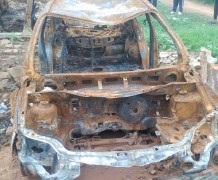


Charred remains of Davou’s cars
IN this compelling expose, MARIE-THERESE NANLONG highlights the growing menace of mob justice in Plateau State, drawing attention to the tragic conseq uences of Iawless ness and communal vigilantism. Through vivid accounts of recent incidents, Nanlong underscores the urgent need for society and authorities to confront this deadly trend before more innocent lives are lost
Plateau State, once celebrated for its hospitality, has in recent years gained a disturbing reputation for mob justice. From lynchings to public burnings, cases of jungle justice have continued to stain communities, leaving grieving families, destroyed homes and unanswered questions in theirwake.
A pattern of lawlessness
In 2022, a young man accused of theft in the Eto Baba area of Jos had little chance to defend himself before an irate mob descended on him, beating him to death in full public glare. His pleas for innocence were drowned in a frenzy of rage. The matter sparked days of tension but quietly fizzled without justice served.
Barely a year later, in 2023, the Tudun Wada axis of the city witnessed another incident. In 2024, the Jenta Adamu community saw suspected cultists lynched before the Police could intervene. Despite investigations and media outrage, the perpetrators largely walked free.
More recently, a woman identified as Cece was almost lynched after being falsely accused of stealing a drunkard’s manhood. These chilling episodes illustrate a grim pattern—a culture where suspicion, fear and misinformation replace the rule of law.
The latest victim, on September 10, was a Police officer, Inspector Lasare Jeremiah, attached to the State Police Command, who died following an attack by a mob at Nyakala Village in Bassa Local Government Area.
Davou’s ordeal, Laraba’s tragic death
Before the death of Inspector Jeremiah, another shocking case emerged in Jos South LGA. The life of Davou Boyi, a physically challenged man from Vom, was torn apart by mob violence.
On April 27, 2025, three children attending Sunday service in the Dankarang community strayed into Davou’s parked car. Two suffocated and died while one survived. Davou, who was at church at the time, only discovered the tragedy upon his return the next day and immediately alerted neighbours, police and vigilante members.
However, rumours quickly spread, accusing him of ritual sacrifice. “They hit me from behind, beat me mercilessly, threw tyres on me, ready to set me ablaze,” Davou recalled. Only the timely arrival of police from Kaduna Vom Division saved his life.
The mob went further—looting and burning his house and destroying property worth overN50 million. His elder sister, Laraba Gyang, a mother of five and civil servant nearing retirement, was dragged, beaten and burnt alive by the mob.
“It was wickedness,” lamented Pastor Ovey Abene, who has known Davou for over two decades. “Davou is a peace-loving man. Those responsible must be punished.”
Calls for justice, end to junglejustice
Lawyers and rights advocates insist that mob action must end. “Mob action is criminal and dangerous. In a civilized society, suspects should be handed over to the Police. Such behaviour can incite ethno-religious violence,” warned Leah Hassan, Chairperson of the Nigerian Bar Association (NBA), Jos branch.
Amnesty International’s Nigeria representative, Sanusi Isa, also demanded justice, urging authorities not to sweep Davou’s case under the carpet.
From Eto Baba to Tudun Wada, Jenta Adamu to Vom, Plateau’s story is stained with repeated mob killings that trample on justice and mock the rule of law. Jungle justice is not bravery. It is sheer barbarism. It is not community protectio. It is cold-blooded murder.
The death of Laraba Gyang and the destruction of Davou’s life must serve as the final warning. Plateau State cannot continue to excuse lawless killings under the guise of anger or suspicion. Therefore, authorities must fish out perpetrators, prosecute them publicly and prove that no crowd is above the law.
Community leaders, religious figures and parents must rise to educate their followers that violence is never justice. If ignored, Davou’s case will simply join the long list of bloody tragedies. But if pursued with seriousness, it can mark the turning point that finally ends mob action on the Plateau.
Society owes it to Davou, to Laraba, and to every past victim of jungle justice to break this shameful cycle once and for all.