


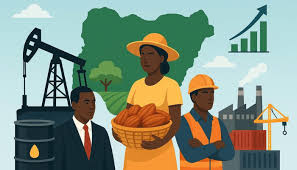

As Nigeria celebrates 65 years of independence, its economy stands as both a story of resilience and recurring challenges. From its agrarian foundations in the pre-independence years, through the transformative oil boom of the 1970s and the structural adjustments of the 1980s, to the democratic reforms of the 2000s and the bold but painful policies of today, the nation’s economic journey reflects a mix of promise and pitfalls. LUCY CHINDABA reviews the trajectory, highlighting the policies, leadership choices and global dynamics that have shaped Africa’s largest economy across the decades
Background
The Nigerian economy is a middle-income, mixed economy and emerging market with expanding manufacturing, financial, service, communications, technology and entertainment sectors. It is Africa’s largest economy, driven mainly by oil, agriculture and services. Oil exports provide the bulk of government revenue, though recent diversification efforts emphasise agriculture, technology and manufacturing.
Agriculture employs a large share of the population, producing crops like cassava, yams and cocoa. The services sector, including banking and telecommunications, is rapidly expanding, supported by a youthful population. However, challenges such as inflation, unemployment, infrastructure deficits and dependence on oil revenues persist. Recent reforms by the administration of President Bola Ahmed Tinubu, including subsidy removal and exchange rate unification, aim to stabilise growth. With vast resources and human capital, Nigeria holds strong potential for sustainable development.
A look at the Nigerian economy right from the colonial era, before independence to after independence from colonial rule, shows a significant shift from what obtained in the past.
Before independence in 1960, Nigeria’s economy was largely agrarian, with agriculture serving as the backbone of production, employment and export earnings. For most farmers, especially in rural areas, farming was subsistent, while larger farmers engaged in commercial agriculture.
Records show that cash crops such as cocoa, groundnuts, palm oil and cotton were the main exports, particularly from the western, northern, and eastern regions respectively. Colonial economic policies emphasised raw material production for British industries, while limiting industrialisation within Nigeria.
Infrastructure such as railways and ports were developed mainly to transport goods for export. Although the agricultural sector thrived, the economy was highly dependent on Britain, with little diversification, leaving Nigeria vulnerable and lacking in local industrial growth and self-sufficiency.
Oil boom, national plans, the SAP era
After independence, the Nigerian economy experienced both growth and challenges. Agriculture initially remained the backbone, providing jobs and export earnings. However, the discovery of oil in Oloibiri in 1958 and its boom in the 1970s shifted the nation’s focus from farming to petroleum, creating rapid revenue growth.
Oil wealth financed infrastructure, education and industrialisation. But this also led to overreliance on petroleum. The agriculture sector suffered neglect, while corruption, poor planning and political instability slowed progress. Despite these setbacks, Nigeria’s large population, natural resources and entrepreneurial spirit remain strong foundations for potential transformation.
Nigeria’s economic plans of the 1970s were largely shaped by the oil boom that transformed the nation’s revenue base. With the discovery and export of crude oil, the government launched ambitious development strategies under the Second and Third National Development Plans (1970–1974 and 1975–1980). These plans were aimed at rebuilding after the civil war, modernising infrastructure and diversifying the economy through industrialisation and agriculture. Massive investments were also made in education, health, transport and housing.
However, heavy reliance on oil revenue led to neglect of agriculture and unsustainable public spending. While the plans spurred growth, they also deepened structural weaknesses in Nigeria’s economy. n the 1980s, with falling oil revenues, mounting debts and economic instability, the government introduced austerity measures, import restrictions and currency controls. These failed to curb inflation and foreign exchange shortages. In 1986, the Structural Adjustment Programme (SAP), supported by the IMF and World Bank, was introduced under General Ibrahim Babangida.
SAP emphasised deregulation, privatisation, subsidy removal and exchange rate liberalisation. While intended to diversify the economy and reduce dependence on oil, the programme caused social hardship, unemployment and increased poverty.
Between the 1990s and 2000, the Nigerian economy faced persistent challenges but also showed signs of gradual reform. The 1990s were marked by political instability, military rule, corruption and a huge dependence on crude oil exports. Falling oil prices and mismanagement led to high inflation, debt burdens and declining living standards. SAP measures continued but caused hardship, with reduced subsidies and rising unemployment.
By 1999, with the return to democracy under President Olusegun Obasanjo, reforms began focusing on debt relief, privatisation and diversification. Though fragile, the economy started regaining investor confidence, setting a foundation for growth in the 2000s.
Economic reforms under democratic rule
The Nigerian economy under President Olusegun Obasanjo (1999–2007) experienced major reforms aimed at reviving growth after years of military mismanagement. His administration pursued debt relief, leading to Nigeria’s historic $18 billion debt cancellation from the Paris Club in 2005. He prioritised privatisation, banking reforms and anti-corruption measures to attract foreign investment. Oil remained the backbone of the economy, but efforts to diversify into agriculture and telecommunications sparked rapid growth in mobile networks. Despite persistent poverty and unemployment, Obasanjo’s policies laid foundations for macroeconomic stability, improved foreign reserves and stronger global credibility.
President Umaru Musa Yar’Adua (2007–2010) pursued policies aimed at consolidating growth and strengthening governance. His Seven-Point Agenda prioritised power and energy, food security, wealth creation, transport, land reforms, education and security. Yar’Adua emphasised transparency in the oil and gas sector through the Nigeria Extractive Industries Transparency Initiative (NEITI) and worked to reduce dependence on oil. However, global oil price volatility and the 2008 financial crisis slowed growth. His health challenges limited policy implementation, leaving many reforms incomplete.
When President Goodluck Jonathan succeeded him, Nigeria’s economy experienced significant growth, becoming Africa’s largest economy after the 2014 GDP rebasing. His administration emphasised diversification, with investments in agriculture, power and infrastructure. The ‘Transformation Agenda’ sought inclusive growth and poverty reduction, though unemployment and inequality persisted. Inflation was relatively stable, and the banking sector recovered after the 2008 crisis. Corruption, mismanagement, and oil theft hindered progress. But Jonathan’s era saw improvements in telecommunications, agriculture and entertainment. President Muhammadu Buhari (2015–2023) faced falling oil prices, recession in 2016, and slow recovery driven by agriculture, telecommunications and services. He promoted diversification through rice production, local industries and infrastructural projects. However, insecurity, inflation, unemployment and foreign exchange shortages persisted. The COVID-19 pandemic caused another contraction in 2020. Despite reforms and anti-corruption campaigns, Nigeria’s economy under Buhari struggled with limited investment and rising debt.
Tinubu’s reform agenda, expectations
President Bola Ahmed Tinubu’s economic agenda, launched in 2023, focuses on structural reforms to stabilise and grow Nigeria’s economy. His administration removed fuel subsidies to reduce fiscal pressure and redirect funds to infrastructure and social programmes. While necessary, this triggered inflation and public hardship. He also unified Nigeria’s multiple exchange rates to attract foreign direct investment and strengthen transparency, while pursuing tax reforms to expand revenue. Tinubu promotes private sector-led growth, digital innovation and job creation.
His economic policies brought both opportunities and challenges. While subsidy removal aimed to reduce government spending, it raised living costs. Exchange rate unification sought stability but initially caused market volatility. Tax reforms targeted improved revenue generation and reduced dependence on oil, fostering diversification. While these policies show long-term potential, Nigerians face immediate hardship from rising prices and unemployment.
To revitalise the economy, government must tackle inflation, stabilise the Naira and reduce the high cost of living. Citizens expect his policies to attract investment, create jobs and support small and medium enterprises. Reports already indicate strong calls for improved infrastructure, stable electricity and efficient public services to boost productivity. There is also a loud cry to tackle systemic corruption, ensure transparency and manage oil revenues more effectively.
With demands for diversification beyond oil, strengthening agriculture and promoting digital innovation, many Nigerians look to Tinubu to deliver inclusive growth and improved living standards. With vast human and natural resources, the economy’s future depends on decisive and transparent management.