


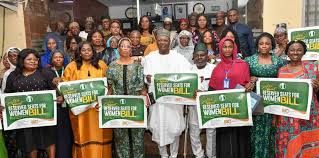

Stakeholders and gender advocates in South South states of Edo, Delta and Bayelsa have said that women’s participation in politics was not a privilege but a necessity.
They called for stronger reforms, reserved seats, and positive perception to enhance women’s representation in governance.
In Edo, Hon. Sally Suleiman, Special Adviser on Sustainable Development Goals (SDGs) to the Edo Governor, stressed that women constituted the backbone of the electoral process.
Suleiman regretted, however, that their presence in leadership remained disproportionately low despite their numerical strength and consistency at the polls.
The special adviser described women’s political participation as essential for inclusive governance.
“For me, women’s participation in politics is not something that should be seen as a favour or privilege. It’s a necessity.
“Women don’t just make up half of society; they are the backbone of elections.
“They vote en masse and are usually more consistent in showing up during the process, yet their representation in leadership doesn’t reflect that strength,” she said.
According to her, when women are part of leadership and decision-making, governance becomes more inclusive and balanced.
“Policies become more inclusive, communities are better represented, and governance feels more balanced,” she said.
While acknowledging that capacity building remained vital, she stressed that structural barriers must also be dismantled.
“What women need to participate fully in politics goes beyond training. Yes, capacity building is important, but the environment itself must be fair.
“The political space can be hostile and discouraging, so we need to create systems that support women such as access to funding, mentorship and protection from intimidation,” she said.
On the issue of affirmative action, Suleiman expressed strong support for reserved seats for women.
“It’s not about giving women positions out of sympathy; it’s about creating room for balance and fairness.
“For too long, the space has been dominated by men, and until there’s deliberate action like reserved seats, the imbalance will continue.
“Once the ground becomes truly level, women will compete and win on their own merit,” she posited.
In her views, Hon. Elizabeth Ativie, former Speaker of the Edo State House of Assembly and current Chairman of the Labour Party in Edo, bemoaned how cultural and traditional barriers continued to make women less visible in politics.
“The truth is, Nigerians by our culture and tradition don’t make women visible, and that’s what is playing up.
“It will take us a very long time to be able to demystify that,” she said
Ativie, however, expressed optimism that the tide was changing, especially with the growing support for special seats for women in governance.
“We have started very well by asking for special seats for women like Ghana and some other countries did.
“What’s even more encouraging is that a man is now sponsoring the bill,” she noted.
According to her, the involvement of political spouses, women leaders across parties, and governors’ wives in the advocacy has brought new momentum to the campaign.
“All the women leaders of political parties are now better informed and are the ones championing the cause.
“That’s a good signal that success is around the corner,” she said.
Ativie urged the National Assembly to pass the bill on special seats for women and called for inclusion of state-level women leaders in the process.
“Once it happens at the federal level, it will flow down to the states,” she said, adding that Edo women deserved at least 35 per cent representation in Gov. Okpebholo’s cabinet.
“It was the women who stood by him when the men were not too sure. Our women don’t decamp, they don’t betray, they don’t sell out, and they work harder than the men when given any responsibility,” she said.
On women’s contribution to national development, Ativie said Nigerian women have proven to be more productive and stable in governance.
“Women are more productive. It’s a research result. They don’t steal, and even if they do, they steal a little, but the men will take everything,” she alleged.
The Edo first female speaker added that women bring focus and integrity to leadership.
“Our women are very stable in any office they hold, and even many successful men rely on their wives for political strength and survival
“If we want faster national growth, then the more women we have in politics, the better,” she averred
Also speaking, Dr Limota Goroso-Giwa, a women’s rights advocate and Executive Director, International Women Communication Centre (IWCC), lamented that negative perceptions and stereotypes continue to limit women’s political advancement.
“When a man wants to join politics, they see him as a leader, but when a woman comes, they say who is sponsoring her, who is her mentor, who is her principal.
“When a woman comes out to participate in politics, the first question people ask is, is she married? Who is she? Whose daughter or whose wife is she?
“Nobody cares about her intelligence; nobody cares about her perception as a human being,” she said.
The women’s rights advocate urged Nigerians to judge women politicians by their competence and ideas rather than by gender or marital status.
“We should not see women politicians as prostitutes, we should not see them as nonentities, we should not see them as mere followers,” she said.
Goroso-Giwa further advocated for a gender quota in the 2027 general elections.
“Next election, INEC should insist on one man, one woman at local and national levels.
“Any political party that does not field any woman for the next election should not be allowed.
“If we have a man as president, we need a woman as the vice, and if we have a man as governor, we should have a woman as deputy. That is the solution,” she suggested.
In Delta, Mrs Bridget Anyafulu, lawmaker representing Oshimili South Constituency in the State House of Assembly, also emphasised the transformative benefits of women’s inclusion in governance.
“Women tend to favour consensus-building, encourage participation from all stakeholders, and focus on crucial matters such as education, healthcare, and family well-being.
“They promote tolerance and respect for alternative views, contributing to a more stable society,” she said.
Anyafulu lamented the marginalisation of women in Nigerian politics, citing data that women hold only 4.2 per cent of seats in the National Assembly.
“In proportion to their population vis-à-vis men, the participation of Nigerian women in politics is low.
“This underrepresentation is part of age-old systemic injustice, discrimination, marginalisation, and deprivation suffered by women in society,” she argued.
To address the disparity, she called for institutionalised reforms.
“We need reserved seats for women in legislative and executive bodies, as well as mentorship programmes to equip them with the skills for leadership.
“Societal barriers such as poverty, violence, and lack of access to education and healthcare must also be addressed,” she pointed out.
Sharing similar sentiments, Mr Matthew Omonade, member representing Ughelli North I Constituency, noted that women’s leadership enhanced accountability and prioritises social well-being.
“There is strong evidence that if more women are elected to office, there would be an increase in policymaking that emphasises quality of life.
“Women tend to work across party lines, help secure lasting peace, and prioritise health, education, and other key development indicators,” Omonade said.
He said women’s participation strengthened democracy, adding that “we must strive for a society where every woman does not just feel safe enough to survive but empowered enough to thrive.”
In Bayelsa, Hon. Sarafina Otasi, former Commissioner for Women Affairs and Social Development, described women as “the engine of growth and development.
“Women’s political participation is a fundamental prerequisite for gender equality and genuine democracy.
“This will facilitate women’s direct engagement in public decision-making and ensure better accountability to women.”
She urged Bayelsa women to register for the ongoing Continuous Voter Registration exercise to enable them to play a greater role in politics.
Similarly, Mrs Beauty Ebiowor, Chairperson of the Women Advocacy Group in Bayelsa, emphasised that reserving seats for women would help institutionalise mentorship and capacity building.
“Giving women opportunities in politics will not only enhance inclusivity but also harness their management skills for economic and social growth.
“Investing in girls’ education is a game changer for communities and nations, leading to healthier families, better incomes, and stronger advocacy for rights,” she asserted.
She added that adopting a female running mate for every male presidential candidate “will be a strong starting point for greater female inclusion.”
For Chief Godson Bako, a community leader from Ogbia, Bayelsa, true national development remains impossible without women’s full participation in governance.
“Women should be given more opportunities to serve because most times they are more prudent and focused than their male counterparts.
“They can contribute more efficiently when it comes to national issues,” he said.
Stakeholders across the zone agreed that women’s political inclusion is not merely a matter of equity, but a catalyst for national progress.
According to them, it is catalyst that can redefine governance, improve accountability, and accelerate sustainable development in Nigeria. (NAN) (