


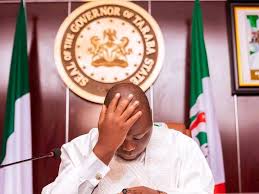

The growing debt profile of Taraba State has sparked widespread concern following revelations that the government may have incurred loans and bonds totalling about ₦1.2 trillion within two years. The development has triggered sharp criticism from opposition voices and civil society figures, who fear the state’s finances could be heading toward crisis. Writing from Jalingo, our correspondent, VICTOR GAI reports that a former member of the House of Representatives, Hon. Danjuma Usman Shiddi (Danji, SS), has publicly accused Governor Agbu Kefas’ administration of reckless borrowing, poor fiscal transparency and a lack of visible results from the massive funds at its disposal
A former member of the House of Representatives from Taraba State, Hon. Danjuma Usman Shiddi (Danji, SS), has raised alarm over what he described as the unprecedented debt profile of Governor Agbu Kefas’ administration, claiming that the state has incurred debts amounting to ₦1.2 trillion since 2023 through various loans and bonds.
In a public letter addressed to stakeholders of the state, the former lawmaker accused the administration of financial recklessness, lack of transparency and failure to deliver tangible results despite massive borrowing and huge federal allocations. He also questioned the efficacy of the government’s free education policy, which he described as “noble in intention but empty in execution.”
Loans without results, unfulfilled education promise
According to Shiddi, all the loans taken by the current administration have not translated into meaningful development, while the much-celebrated free education policy has failed to achieve its objectives.
“When Governor Agbu Kefas stood before the people in 2023 and declared free and compulsory education, many hearts swelled with hope. Parents exhaled. Children dreamed. He promised uniforms, textbooks, and relief from school fees.
He declared an ‘emergency on education,’ vowing that poverty would no longer bar a child from learning. It was noble. It was inspiring. But dreams, no matter how grand, must learn to walk — and this one has not taken a single step,” Shiddi lamented.
He questioned the utilisation of funds meant for educational supplies, asking, “Where is the ₦17 billion awarded to acquire uniforms and school items from China for school children? Where are the books, the desks, and the roofs over our children’s heads?”
The former lawmaker accused the state of promoting illusion over substance, asserting that “when leaders manufacture the appearance of progress while decay deepens underneath, the tragedy becomes complete.”
A mountain of debt amid rising federal allocations
Shiddi detailed a series of loans and bonds allegedly obtained by the Kefas administration, including a ₦206.78 billion loan approved by the Taraba State House of Assembly in August 2023 from a consortium of banks—Zenith, UBA, Fidelity and Keystone.
He further claimed that in March 2025, the government announced a ₦350 billion bond, followed by a $268.63 million facility (about ₦510 billion) from the ECOWAS Bank for Investment and Development (EBID) in October 2025.
“Add them all together, and the picture becomes chilling,” Shiddi declared. “In barely two years, the administration has borrowed or secured approvals exceeding ₦1.2 trillion — a staggering figure for a state whose Internally Generated Revenue in 2023 was only ₦10.87 billion.
“A state that earns ₦10.87 billion a year cannot repay ₦1.2 trillion without selling its soul. This is not governance; it is gambling — with our future, our children’s inheritance, and the faith of a people who trusted their leaders to act with restraint.”
He further queried the lack of transparency surrounding the loans: “We are told that the EBID loan will fund energy, agriculture, and industrialisation — beautiful promises indeed. But where are the projects? Where are they located?
“Who are the contractors? What are the timelines, and at what cost? No one knows. In Taraba, questions die before they are answered. Silence has become our official policy, and applause, our proof of progress.”
Shiddi also pointed out that despite receiving ₦437.21 billion in federal allocations between mid-2023 and mid-2025, there was little to show for it in terms of infrastructure, schools, hospitals or workers’ welfare.
Comparisons with past administrations, fiscal mismanagement
The ex-lawmaker contrasted the current government’s approach with previous administrations, which he said exercised more restraint and fiscal prudence.
“To truly see the scale of our decline, we must look backward. Under Governor Danbaba Suntai, Taraba maintained a cautious fiscal stance — external debt averaged about $18 million in 2007 as provided by the Debt Management Office. Under Governor Darius Ishaku, that restraint gave way to expansion: domestic debt rose from ₦14.6 billion in 2018 to ₦105.98 billion by 2022,” he said.
“Today, under Governor Agbu Kefas, the debt remains high — ₦93.18 billion in 2023 and ₦87.96 billion in 2024. Meanwhile, monthly FAAC inflows in 2023 ranged between ₦5 billion to ₦8 billion per month, and Taraba’s internally generated revenue, according to the National Bureau of Statistics, was ₦10.87 billion — the third lowest in Nigeria.”
He described the ₦50 billion loan from the United Bank for Africa for “local government infrastructure” as another burden on already struggling councils, arguing that it amounted to “economic suicide.”
Comparing performance, Shiddi said: “During the era of Darius Ishaku, with lower allocations and modest IGR, there was still visible progress — roads, schools, water schemes, and community projects. He governed within his means. The current administration governs within illusion.”
Call for legislative oversight, fiscal responsibility
Shiddi strongly criticised the Taraba State House of Assembly for failing to check what he termed “executive recklessness,” calling it a “rubber stamp legislature.”
“I now turn to the State House of Assembly — that hallowed chamber that too often mistakes applause for duty. Gentlemen, history is watching. You were not elected to clap. You were chosen to question, to check, and to act as the conscience of the state,” he declared.
He urged the legislators to exercise their constitutional powers under Sections 128 and 129 to investigate the loans and hold the executive accountable. “Each time you raise your hands to approve another loan without scrutiny, you sign another page in the story of our children’s enslavement,” he warned.
Shiddi also drew attention to other states like Zamfara, Nasarawa and Ogun that, according to him, have made progress without resorting to excessive borrowing.
“In Zamfara, Governor Dauda Lawal rebuilds without loans, tapping into mining and agriculture. In Nasarawa, Governor Abdullahi Sule courts investors, not creditors. In Ogun, the government has generated over ₦126 billion in IGR this year alone.
“Taraba — rich in land, solid minerals, and people, richer than them all — remains a debtor. Why do we borrow what we can grow?” he queried.
He concluded his statement by calling for a complete halt to further loans until audited reports of existing ones are made public. “Let there be light where there has been darkness, and truth where there has been theatre,” he said. “Our borrowing now exceeds what the state will earn in four years. This is not progress; it is plunder.”
At the time of filing this report, there was no official response from the Taraba State Government regarding the allegations. Efforts to reach government officials for comment were unsuccessful, as their lines remained unreachable.