


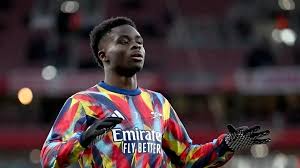

Arsenal and England winger, Bukayo Saka, has opened up about his deep connection to his Nigerian heritage.
He explained and emphasised how his family’s background has profoundly shaped his identity and values.
Despite being raised in England, the 22-year-old has maintained a strong bond with the homeland of his parents, who both grew up in Nigeria before emigrating.
Although he has represented England from the U15 level up to the senior team, Saka has always spoken about his connection with his Nigerian roots.
The Arsenal star credits his parents for instilling in him a strong sense of culture and discipline.
In a recent interview with the BBC, he proudly shared his full name and its significance.
“My name is Bukayo Moses Ayoyinka Temidayo Saka.”
“I am very proud of it [my Nigerian roots],” he stated.
“Both my parents grew up in Nigeria, so many of their values have been instilled in me.”
His ties to the country were further highlighted in June 2023, when he was officially received by Lagos State Governor Babajide Sanwo-Olu at the State House in Marina, Lagos.
Saka’s connection to Nigeria extends beyond family ties.
Ahead of the 2022 World Cup, he partnered with the children’s charity BigShoe to finance 120 life-altering operations for children in Kano, Nigeria.
The surgeries addressed serious medical issues such as hernias and brain tumours, offering a brighter future to underprivileged youth.
Saka recently had the honour of captaining Arsenal to a 4-1 win in their Premier League fixture against North London rivals Tottenham Hotspur at the Emirates Stadium.
PULSE SPORTS NG
D’Tigers announce squad for 2027 FIBA W’Cup qualifiers in Tunisia
Nigeria’s senior men’s basketball team, D’Tigers, have confirmed their final 12-player squad for the opening window of the 2027 FIBA World Cup African Qualifiers, scheduled to take place in Tunisia.
Head coach, Abdulrahaman Mohammed, revealed a roster that balances seasoned professionals with rising stars from the Nigerian league, a strategy aimed at restoring Nigeria’s dominance on the continental stage.
The squad is headlined by veteran guard, Stanley Okoye, a 2015 AfroBasket champion and one of Nigeria’s most experienced active players.
His leadership and international pedigree are expected to provide stability in a tough qualifying window.
Several foreign-based players also make the list, including Jordan Ogundiran (Denmark), Ike Nwamu (Ankara, Turkey), Mike Nuga (Canada), Simon Ugochukwu (Italy), Talib Zanna (USA), Udeze Morris Chidera (Spain), Olisa Akinobi (USA) and Augustine Okafor (United Kingdom).
The roster also features three standout players from the Nigerian basketball league.
They are Chinkpa Garba (Lagos Legends), Obekpa Chris (Lagos Legends), and Paul Dibal (Gboko City Chiefs).
D’Tigers will compete in Group C, facing Rwanda, Guinea and host nation Tunisia.
The African qualifiers will be played across five windows, running from November 2025 to February 2027, with teams battling for limited World Cup spots.
PULSE SPORTS NG
Should Chelle remain as S’Eagles coach?
After the disappointing ouster to DR Congo, it is probably time to engage with the elephant in the room: does Eric Chelle, having fallen short of his 2026 World Cup mandate, deserve to remain in the post of Super Eagles coach?
The Malian took the reins in January 2025 with an express directive to right the listing Nigeria ship at a crucial period.
Despite failing to chase down South Africa outright, he was handed a second crack via the CAF playoffs, where he once more fell short despite the three-time African champions being overwhelming favourites and the highest-ranked nation in the mini-tournament.
The case to retain Chelle
Since taking the role, the Malian has been in charge for 11 matches.
In that span, he has yet to suffer defeat outright. (Penalty shootouts are logged as draws.)
Statistically, of the three Super Eagles coaches through the World Cup qualifiers, Eric Chelle has comfortably the best points per game ratio (2.33) in the series, exempting the playoffs.
While he did not fulfill his mandate to the letter, he came close enough that penalising him would be harsh in the utmost.
Leaving aside the results on the pitch, there is also the fact that the 2025 Africa Cup of Nations (AFCON) kicks off in just over a month.
Any upheaval in the dugout would almost certainly be disastrous; the last time Nigeria made a coaching change this close to the AFCON, they suffered their earliest exit from the competition in 40 years.
Surely, a better course of action would be to let him take charge of the tournament, and then evaluate afterward?
The case to fire Chelle
Whatever one could say in Eric Chelle’s defence, the bare truth of it is that he did not do what he was employed to do.
The unspoken of his imperative was that he needed to win all six qualifiers; he ended up winning four.
Had he won five, Nigeria would have punched a ticket to the World Cup. Easy peasy.
The argument that he is still undefeated falls down slightly when you consider that it was not necessarily defeats that had put Nigeria in a difficult position to begin with, but a lack of wins.
The reason for that inability to convert draws to wins was, ostensibly, the injury-enforced absences of talisman Victor Osimhen over the first four matches.
Chelle has a much stronger 2026 WCQ record as Super Eagles coach than Jose Peseiro or Finidi George, but arguably only because he was the only one of the three who had the services of Osimhen.
There is also his proneness to panicking under pressure, which might not bode well at a major tournament.
One has only to remember the last time he coached at the AFCON, and the viral meme it birthed, to understand this.
AFRIK-FOOT NG
Israel pledges to strengthen Nigeria ties through sports
The Ambassador of Israel to Nigeria, Michael Freeman, has reaffirmed the embassy’s commitment to deepening Nigeria-Israel diplomatic relations in the area of sports.
Freeman communicated this Saturday during an event celebrating the life of Moshe ‘Jerry’ Halevi, Nigeria’s first football manager and coach, who served from 1960 to 1961.
The envoy said Halevi, who was born on November 14, 1912, and died on February 3, 1997, was a good manager who designed the style and laid the groundwork for Nigerian football.
“When you are an ambassador, you learn a lot of interesting things.
“One of the things I learnt is that the very first coach of Nigeria national team after independence was Jerry.
“If he was alive, he would have been 130 years of age.
“It would have been appropriate that we are going do something to celebrate his life, also celebrate football, other sports and everything that brings us together,” he said.
Speaking at the event, the Minister of Sports Development, Shehu Dikko, commended Freeman for the initiative to posthumously celebrate Halevi, saying such would deepen Nigeria-Israel ties.
He said Nigeria appreciated the foundation laid by Halevi in the advancement of the nation’s football.
“This reminds me that it is good to do something good; Jerry was here 1960 – 1961 and we are remembering him today.
“At least, all of us here from the sporting system have to learn something.
“When we leave here, we have to also start honouring our people and to honour what they have done for the country, which is a way to encourage those coming up.
“The plans you have, particularly for them shows what sports and indeed, football can do for us; football in Nigeria is more than religion, it is what binds us together and brings everyone together.
“Whatever we need to do collaboratively between Nigeria and Israel, we will support that; may Halevi’s soul rest in peace,” he said.
The event was attended by John Fashanu, a Nigerian-born former professional footballer who played as a centre-forward for England.
Others included Kanu Nwankwo, Nigerian former professional footballer, who played as a forward, Daniel Amokachi, Nigerian football manager and former professional player, as well as diplomats and industry experts.
(NAN)
CAF delays AFCON 2029–2035 host announcement amid competitive bids
The Confederation of African Football (CAF) has pushed back its decision on the host countries for the Africa Cup of Nations (AFCON) tournaments scheduled between 2029 and 2035.
The postponement followed the latest meeting of the CAF Executive Committee, which confirmed that further assessment is needed before finalising the host selections.
Five bids are currently in contention for the seven-year hosting cycle.
Angola, Rwanda, Ethiopia and Senegal have each submitted individual proposals, while Mali and Guinea are jointly seeking hosting rights.
The extension of the evaluation period highlights the competitiveness of the process, as interested nations continue to lobby and work toward meeting CAF’s infrastructure benchmarks.
Whichever countries eventually emerge successful are expected to gain significant economic, developmental and infrastructural advantages, given the long-term nature of the hosting tenure.
CAF is expected to release new dates for the final announcement, with many stakeholders urging a transparent and well-structured approach to the decision-making process.
PULSE SPORTS NG