



BUSINESS
KENNETH DARENG reports that event though there has been a noticeable drop in the prices of several staple food items across Nigerian markets following a relatively successful farming season, weak purchasing power driven by widespread hardship, inflation and lingering policy failures continues to limit access to food for many households
Despite the resurgence of insecurity this outgoing year, and just like in the past few years when some farmers across many parts of the country were unable to access their farms due to the threat of attacks by bandits or terrorists and were forced to abandon their farms, the story this year appears rather different. Fortunately, nature was kind to the few that mustered the courage to continue with their farming activities, especially farmers in the North-East, North-West and North-Central regions, including other parts of the country where abundant rainfall was recorded with few natural disasters, resulting in a bumper harvest this cropping season.
Between the months of September and October this year, prices of commodities such as rice, sorghum, maize, millet and yams dropped drastically, and prices have remained relatively stable from November to December. This contrasts sharply with last year when prices of staple foods such as rice, beans and yams witnessed daily increases across Nigerian markets.
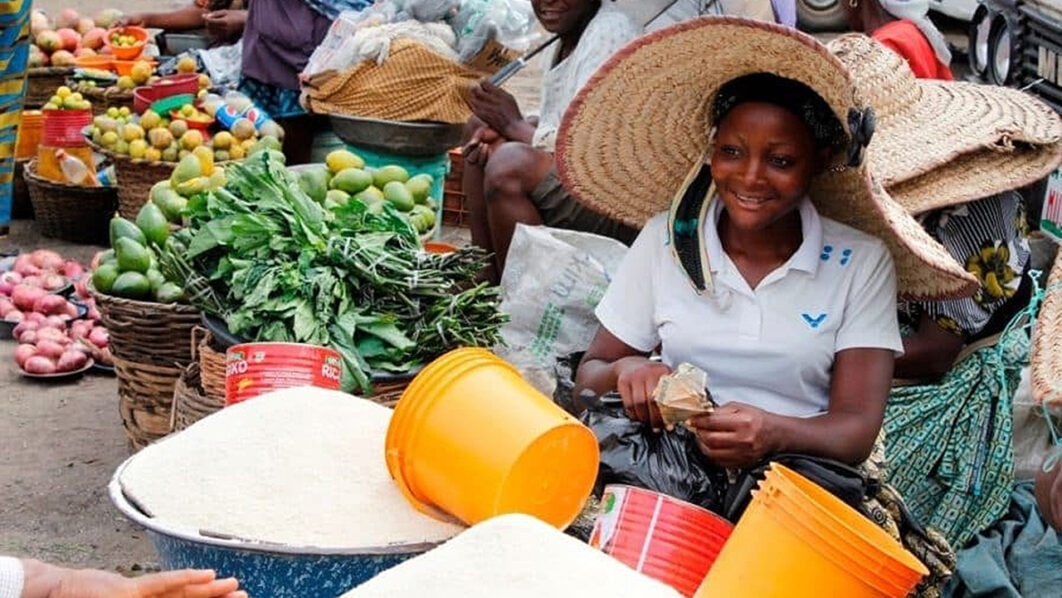
For instance, a bag of sorted rice sold for between N95,000 and N100,000 in December last year, while a mudu of grains such as maize was between N700 and N800. As at this December, however, a bag of sorted rice sells for about N65,000. A bag of flour, which sold for N55,000 last year, now goes for about N60,000, while a mudu of maize now sells for between N250 and N300 respectively.
Other commodities such as yam, beans, cooking oil and farm produce including onions, tomatoes, pepper and other cooking ingredients remain relatively stable and affordable, unlike fish, beef and chicken, which are almost beyond the reach of the average Nigerian household.
Low patronage despite price drop
A visit by THE NIGERIA STANDARD correspondent to markets such as Terminus, Chorbe and Kabong Satellite Market in Jos metropolis showed very low patronage by customers. In a chat with the reporter, a grains seller, Madam Cecilia Akus, said: “Normally, as we approach Christmas, families try to stock their homes with grains in readiness for the new year and take advantage of the fact that attention is mainly on rice because of the Christmas season. This is usually the time prices of grains drop, but this time around, even with the drop, there is very low patronage and I don’t even know why.”
Also lamenting the situation, a rice retailer, Sabastine Okoro, attributed the low patronage to the present level of hardship among many Nigerians. According to him, “The present poverty level is no doubt biting harder by the day, which has also forced a vast majority of people to seek other alternative means of survival. Those who cannot afford rice or beans are now opting for sweet potatoes, which are more affordable and easier to prepare.”
However, a customer, Madam Mary Abu, argued that there was no real drop in prices.
“Rather, things are getting tougher by the day, especially with the rise in prices of goods and services, particularly at this time of the year. My husband lost his job in the bank, and I am just coming from the market where I bought a kilo of meat at N6,000. I also priced a chicken, and the one I saw was between N25,000 and N30,000.
“What goes up in this country hardly goes down. As you can see, market forces are at work, and as a housewife managing a small hair salon business, what can one do? This means the poverty level of Nigerians is on an unimaginable dimension which needs to be addressed by government,” she said.
Anthony Chuhwak, a primary school teacher in Jos North, also blamed the situation on broader economic issues. According to him, “What we are witnessing could be as a result of a high inflationary rate coupled with large-scale corruption by public office holders and bad government policies that have sent many people to seek refuge outside the shores of the country. The lack of political will by governments at the three tiers to tackle insecurity in all parts of the country is a major setback that is making life miserable for all of us.”
Policy failures, cash scarcity
In the course of these conversations, some Nigerians advocated the establishment of a Price Control Board to check arbitrary price increases on commodities, with a view to curbing the excesses of traders who maximise profit at all costs.
However, some economic experts have attributed the weak purchasing power of consumers to the devaluation of the naira in 2023 by the Central Bank of Nigeria (CBN), alongside the naira redesign policy, which led to hoarding and slow circulation of the nation’s currency. This caused a major economic shock that triggered double-digit inflation, negatively affecting businesses.
Despite efforts by the CBN to find solutions, the problems appear unabated due to foreign exchange scarcity, high reliance on cash for daily life in an informal economy, weak infrastructure, corruption and poor policy implementation, all of which have led to liquidity challenges affecting businesses and citizens alike.
Although last year the CBN attempted to reintroduce redesigned higher denomination naira notes to pull hoarded cash back into the system, the implementation was poor, resulting in major disruptions, cash shortages and public anger.
The question begging for an answer is where the money is, given the relative drop in prices of commodities. The answer may not be far-fetched, as much of the cash in circulation is now domiciled with Point of Sale (PoS) operators. Most banks, according to findings, do not have sufficient liquidity to meet customers’ demands, with withdrawals often limited to certain amounts.
Lydia Tanko, a PoS operator, said: “Most PoS businesses are owned by banks, although I normally source larger amounts from traders who prefer to deposit their money without the stress of going to the bank directly. So the notion of money scarcity may not be entirely true, as there is no amount of money a customer would request that cannot be sourced immediately. Even cash wallets operated by MoniePoint or Opay are licensed and run by microfinance banks, which means the same value chain ends up at the banks.”
Inflation, outlook and the way forward
However, in a cash-dominant economy, many daily transactions involving street vendors and the transport sector still require physical cash, making shortages severely impactful. Factors such as high inflation, unemployment and currency devaluation arising from the foreign exchange crisis reduce disposable income and increase demand for basic cash access.
According to financial experts, dependence on oil revenue and deficit spending create broader economic instability that affects currency value and liquidity. In essence, the cash scarcity experienced in 2023 is still having ripple effects on the Nigerian economy due to poor policy execution, which has exacerbated existing poverty and economic challenges.
Consequently, efforts to access food, fuel, healthcare and education have been disrupted, while business inefficiency has created liquidity and operational cost challenges for many enterprises.
Meanwhile, the National Bureau of Statistics (NBS), in its 2025 inflation report, indicated that in October 2025 the inflation rate stood at 0.93 per cent, while food inflation during the same period was 13.12 per cent. The report also showed a decrease in inflation on a month-on-month basis by 1.21 per cent compared to September 2025, which stood at -1.21 per cent.
The present weak purchasing power among Nigerians serves as a wake-up call for families to plan ahead as the new year beckons, amid expectations of further challenges. It also calls for a more pragmatic approach and workable, effective monetary policies by the Federal, State and Local Governments to stimulate the economy towards prosperity and pull the nation out of its present difficulties.