


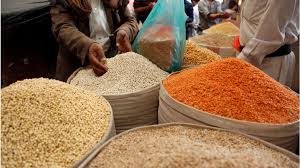

In spite the decline in food inflation across Nigeria, many residents of the Federal Capital Territory (FCT) have decried their inability to purchase staple food items.
The residents, who spoke to the News Agency of Nigeria (NAN) on Sunday in Abuja attributed the development to low purchasing power and income.
“Although, some food items have slightly reduced in price, the difference is not yet significant enough due to limited income,’’ they said.
According to the data released by the National Bureau of Statistics (NBS), the country’s annual food inflation rate dropped to 16.87 per cent in September 2025, down from 21.87 per cent in August.
The report said that the reduction was largely due to the seasonal harvest of grains such as maize and millet.
At the Apo market, NAN reports that a bag of local rice formerly sold at N75,000 is now N57,000, while a foreign brand which was sold between N90,000 and N100,000 is now N70,000.
A bag of iron beans goes for N108,000, while brown beans cost N118,000, slightly lower than the N135,000 and 145, 000 recorded earlier in the year.
A bag of white garri sold for N65,000, now sells for N60,000, while a 25-litre jerrycan of groundnut oil and red oil cost N75,000 and N77,000 respectively.
A dustbin basket of pepper is sold for between N2,000 and N2,300, while a similar basket of tomatoes ranged from N5,000 to N6,500 as against N7,500 sold in September.
Onions is presently being sold for N90,000 per bag, with dustbin basket selling for N4,000 to N4,800.
A kilo of frozen chicken remained at N4,800, while beef and goat meat sold for N7,500 per kilogram, NAN reports.
In Orange Market, the survey revealed that prices of some food items increased while others dropped in the past two months.
A dustbin basket of big red Tomato is being sold at N6,000 as against between N5,000 to N7,500 as the price keeps fluctuating.
A dust bin basket of tatashe is being sold at N5,500 as against N3,500 while onions witnessed a slight increase as a dustbin basket is sold at N4,500 as against N3,500 and N4,000.
However, the price of pepper dropped significantly; a dustbin basket is being sold at N1,500 as against N3,000.
Also, the price of Irish Potato dropped significantly. A dustbin basket is sold at N3,700 as against N7,000 to N8,000.
In Wuse market, a dustbin basket of tomatoes sold for N9,000, while onions of the same measure cost N6,500. Beans sold for N2,500 per measure, and a plate of pepper (rodo) was sold at N2,000.
At Lugbe market, a 50kg bag of Big Bull rice that previously sold for N95,000 now costs N55,000, while Optimum rice dropped from N65,000 to N56,000.
Five tubers of yam that previously sold for N15,000 are now sold for about N8,000, while a mudu of beans dropped from N2,500 to N1,800.
In Nyanya market, a basket of onions sold between N3,500 and N4,500 as against N6,000 sold in August while tomatoes went for N3,500 to N5,000, depending on the type.
NAN reports that at Lugbe market, sweet potatoes sold for between N2,500 and N3,000, down from N3,500 to N4,000 last season.
The survey revealed that in spite of the reduction in food prices, many households are struggling to feed and make ends meet due to low per capital income.
Mr John Okeke, a civil servant, said the price reduction had not translated into affordability for the average Nigerian.
“If food prices have dropped, are they affordable to the common man? Has transport reduced? Has fuel reduced? We must consider all these before claiming that the economy is improving,” he said.
Mrs Agnes Edoh, a nurse and mother of three also decried the pressure she faced in maintaining her home due to limited funds.
Edoh, who acknowledged reduction in some staple food prices, appealed to the government to do more and increase workers’ salaries to boost their purchasing power.
“Even with this reduction many people are singing. The money is still not there to purchase these items.
“After paying rent, school fees, transportation and other miscellaneous, you will discover you have little or nothing left for household care.
“The government and other relevant bodies should please come to our rescue and improve the economy further for the good of Nigerians,” she said.
Meanwhile, the Minister of State for Agriculture and Food Security, Mr Aliyu Sabi, attributed the decline in prices to improved local production and government intervention programmes.
He said the administration’s National Agricultural Growth Scheme (NAGS) Agro-Pocket Programme injected more than 500,000 metric tonnes of wheat and similar volumes of maize, cassava, and other crops into the market, which helped moderate food prices.
(NAN)